


When choosing between piston‑type compressors and diaphragm compressors, there is often debate over which is better. While manufacturers of oil‑free piston compressors claim their products are superior, diaphragm compressor manufacturers argue that their technology offers a better solution. The reality, however, is that there is no clear‑cut answer.
The right selection depends on a range of factors, including: ‑ The gas to be compressed; ‑ Required operating pressure; ‑ Required volumetric capacity; ‑ Clean‑liness requirements for the compressed gas (acceptability of oil / oil vapor).
In this article, we will take an in‑depth look at these factors to help you determine which compressor is best suited for your requirements.
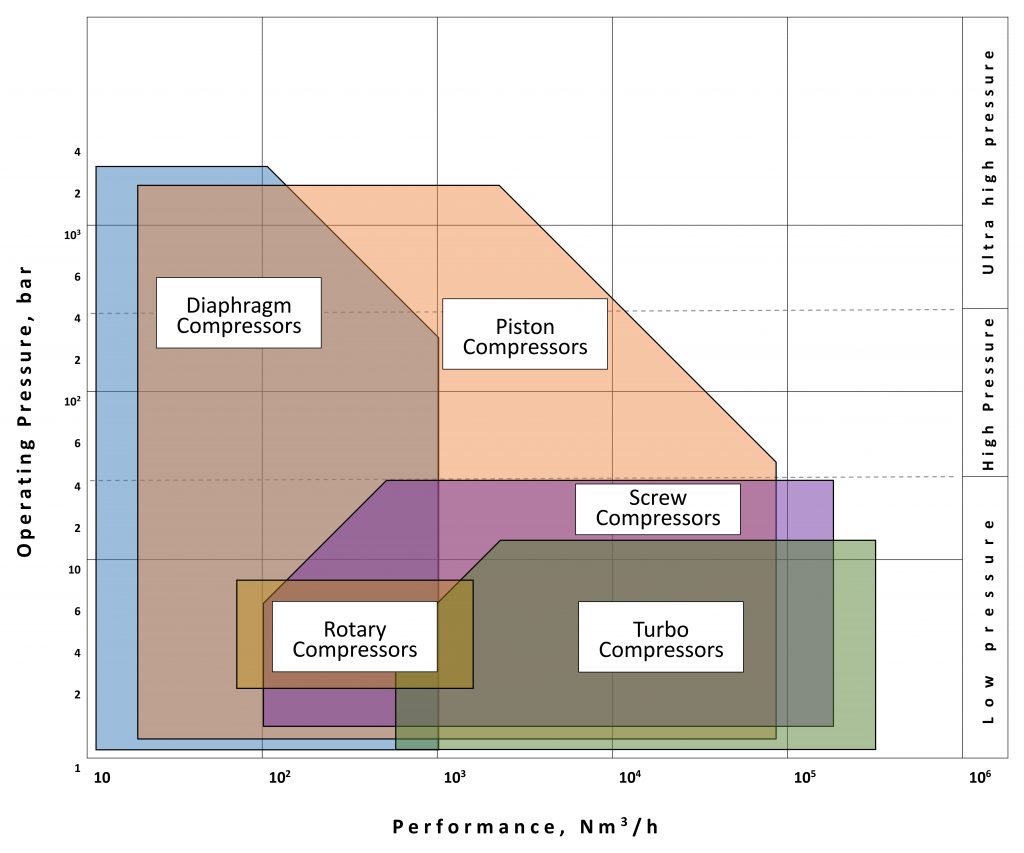
The figure above shows that a wide range of capacities and operating pressures can be covered. Nevertheless, piston‑type compressors are the preferred choice for high operating pressures above 15 bar and high‑capacity applications above 15 bar, whereas diaphragm compressors represent the only option for certain higher operating pressures. The overlapping area in the diagram of Fig. 1 indicates the range where both types are applicable, and more specific selection factors come into play within this zone.
The main similarity between diaphragm compressors and piston‑type compressors is that both feature an oil‑filled crankcase housing the crank‑linkage mechanism (CKM). In addition, the number of rods and pistons in both compressors corresponds to the number of compression stages of the compressor. Apart from these common features, however, the two compressor types differ in design and operation. Their further differences are summarized in the table below.
特性 活塞式压缩机 隔膜压缩机 压缩气体 活塞式压缩机由于其结构中使用的材料,适用于压缩有限范围的气体。可压缩气体的具体列表取决于活塞、活塞环、气缸和其他部件的材料。 它们几乎可以不受限制地压缩任何气体。因为压缩气体只与高质量、耐腐蚀的钢制部件接触。 驱动器类型 活塞式压缩机可以通过皮带驱动,也可以使用带有弹性元件的联轴器直接驱动。 隔膜压缩机通常是皮带驱动的,直接驱动的情况很少见。 转速 它可能会有所不同,但在更高的速度下,压缩机的振动会增加,因此在将其放置在地基上时必须安装隔振支架。 它们的转速通常较低,通常最高为 500 rpm。低转速导致运行过程中的振动小,因此在将压缩机安装在基础上时无需隔振。 级压比(每个压缩机级的吸入压力与排气压力之比) 作为一般规则,活塞式压缩机的级压比限制为不超过 1:8。如果比率较高,则可能导致压缩阶段过热。 隔膜压缩机的级压比通常大于 1:15。这种高压缩比使压缩机能够以比活塞式压缩机更少的级数实现高出口压力。 冷却 活塞式压缩机可以是风冷式或水冷式。风冷式压缩机从正在运行的风扇中产生相当大的噪音,需要去除房间内的热空气。风冷压缩机的气缸通常带有翅片,这使得设计更加复杂和昂贵。相比之下,水冷式压缩机使用水作为冷却介质,通常比风冷式压缩机更安静。 隔膜压缩机通常是水冷式的;在某些情况下,可以使用组合冷却。它使用一个额外的泵在闭路中循环冷却剂,并冷却由风扇吹起的散热器中的液体。然而,这种冷却系统具有传统空气冷却的缺点。此外,由于使用额外的泵和散热器,组合式冷却系统可能会很昂贵。 压缩气体与油的接触 可压缩气体和油之间的接触存在于油润滑活塞式压缩机中。它限制了它们用于压缩清洁气体,因为存在被油污染的风险。然而,在无油压缩机中,由于活塞环或轴填料会阻止油进入压缩室,因此气体和油之间没有接触。但是,如果将压缩室与油路分隔的环磨损,则存在油蒸气或进入的风险。在这种情况下,没有防止油进入的紧急保护,这可能导致压缩气体受到污染。 由于采用三层隔膜,隔膜压缩机的可压缩气体与油没有接触。这种设计确保油与气体完全分离,即使其中一个隔膜破裂,也会导致压缩机立即紧急停止。因此,隔膜式压缩机适用于压缩各种气体,而不会因与油接触而受到任何限制。 摩擦部件的润滑 活塞式压缩机的摩擦部件通常通过飞溅润滑或强制润滑进行润滑。在十字头压缩机中,需要称为润滑器的特殊装置来润滑活塞和气缸。监控这些设备的运行并正确调整它们至关重要,因为润滑器的故障会导致癫痫发作等灾难性后果。在无油压缩机中,气缸和活塞不需要润滑。但是,它们需要独特的材料和更复杂的冷却系统来确保正常运行。 曲轴箱的部件通过飞溅或强制润滑进行润滑。气体的压缩是通过隔膜的运动实现的,隔膜将液压油和被压缩的气体分开。液压油是将压力从驱动机构传递到隔膜的介质。这种设计消除了气体压缩部件的润滑需求,因为气体和任何摩擦部件之间没有直接接触。 立即调整每个阶段的排放压力的可行性 不可用。 隔膜式压缩机允许使用液压旁通阀调节每级的最终压缩压力。它可以在现场轻松快速地改变压缩机的压缩特性。 紧密 活塞式压缩机的压缩室(气缸)用固定(垫圈等)和可移动(压盖等)密封件密封,以确保密封性。然而,移动的密封件容易受到机械磨损,因此需要定期监测其状况。 在隔膜压缩机中,压缩室的密封性仅由固定密封件保持。活塞式压缩机没有可移动的密封件,因此没有机械磨损。 易于维护 活塞式压缩机的维护可能既复杂又耗时,具体取决于压缩级数的设计和数量。单作用和双作用压缩机可能需要不同的维护程序,并且润滑器等附加设备也会影响维护过程。可能需要专门的设备和工具,只有合格的人员才能进行维护,以确保正常运行并防止损坏压缩机。 隔膜压缩机的维护相对简单,不需要专门的设备或高技能的技术人员。压缩机的设计简单易用,因此可以直接更换隔膜和密封件等部件。
This additional information is also essential for your selection.
Diaphragm compressors are well‑suited for compressing clean / ultra‑pure / toxic gases, where even the slightest contact with oil vapor inside the compression chamber is unacceptable.
Diaphragm compressors can handle any inlet pressure, while piston‑type compressors have limitations in this respect.
For diaphragm compressors, the gas to be compressed must be dry and moisture‑free to prevent accelerated wear and premature failure.
Diaphragm compressors are larger and more costly than reciprocating compressors of comparable characteristics.
Diaphragm compressors are recommended for compressing expensive, rare and pure gases, so as to avoid substantial losses caused by contaminants and oil vapor.
 |
TELEPHONE |
 |
Address:18 Kailu Avenue, Jianshe Road, Liangxiang, Fangshan District, Beijing |
 |
Email:info@taneor.com |
 |
Tel:(+86)13601381607 |

